She asked for scripts.
She needed a system.
What a Handled delivery for a senior cost-controls engineer at a major general contractor looks like: we listened to the problem under the request and built to that, not to the request itself.
Problem → Plan → Solution. You describe what you need, we respond with a detailed plan, and if you say go, we build the solution.
No credit card. The Plan delivered in 5 business days.
— A real estate construction lawyer
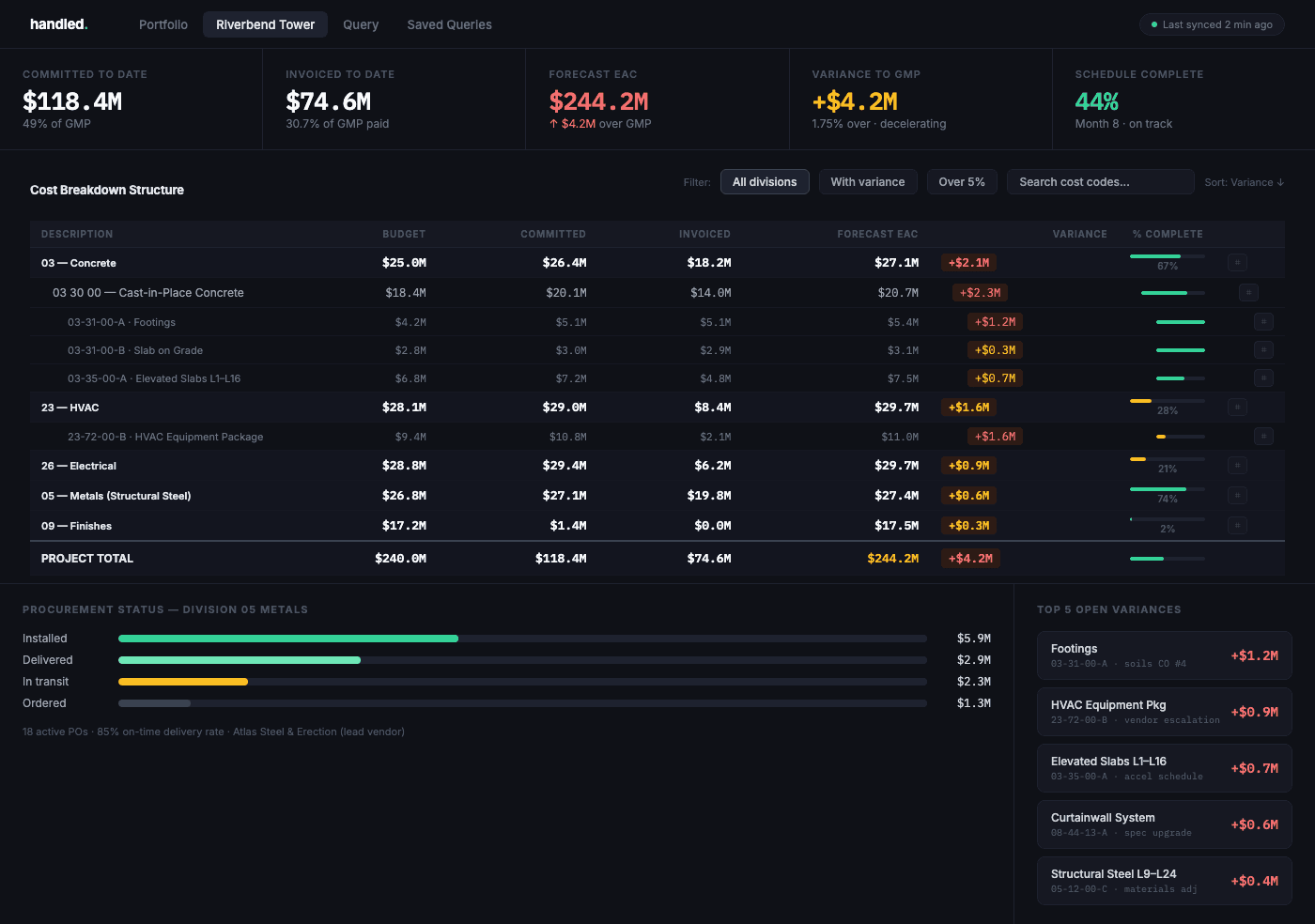
You run cost controls on three to five mega-projects. Every detail of every project lives in a stack of eight Excel workbooks you maintain by hand. Every day, fifteen people — project managers, executives, procurement leads — ping you with questions: what's our committed cost, where's the variance, how much steel is delivered, are we on track to hit the GMP. Every question takes five to thirty minutes to answer. You run the spreadsheet, you run the lookup, you write the email. You're the only person who knows where everything lives. If you take a day off, the company stops being able to answer questions about its own projects. She asked us for some Python scripts. We listened to the problem under the request and built a system instead — a live cockpit reading directly from her workbooks, a natural-language query interface for the questions that don't fit a dashboard, and a saved-script library for the calculations she runs on herself. Every answer cited back to the source row.


Built by professionals, for professionals.TheAIMasters, LLC
What we built
Open the live demo (synthetic Riverbend Tower data)→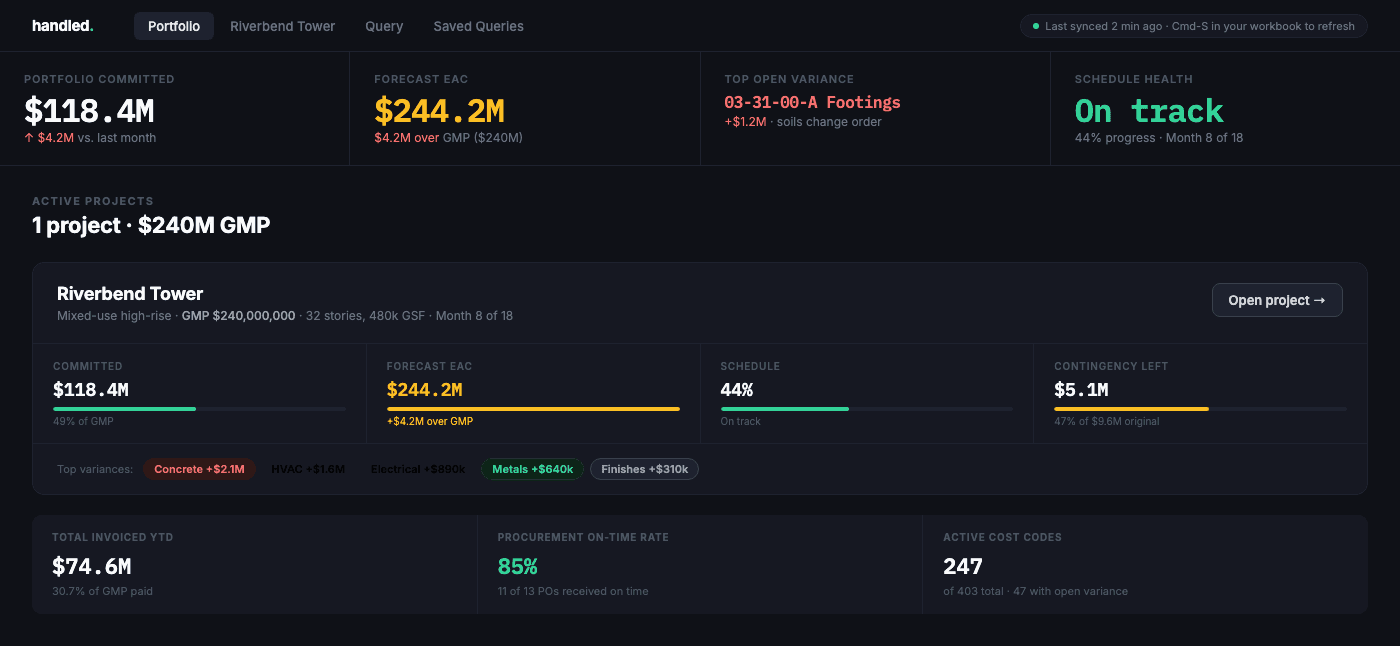
How it worked
The pipeline is the boring part — that’s the point. Here’s how the recordings became a permanent site.
We listened to the problem under the request
She asked for Python scripts. We asked: what would the scripts answer? Twelve questions, every day, mostly the same twelve. Scripts answer one question at a time. A system answers all of them, faster than people can ask. We scoped to the system.
Workbook walkthrough
Thirty minutes of screen-share over her real workbooks. We mapped the schema — sheet purposes, cross-references, named ranges, the cost code structure, the meaning of every color and font convention. The walkthrough produced a schema doc that became the data contract.
ETL pipeline built
A small Python service watches the workbook directory; on every save, it extracts the changed sheets into a clean analytical database. Every row preserves its source coordinates — file, sheet, cell range — so the audit trail follows the data into the cockpit.
KPI library defined
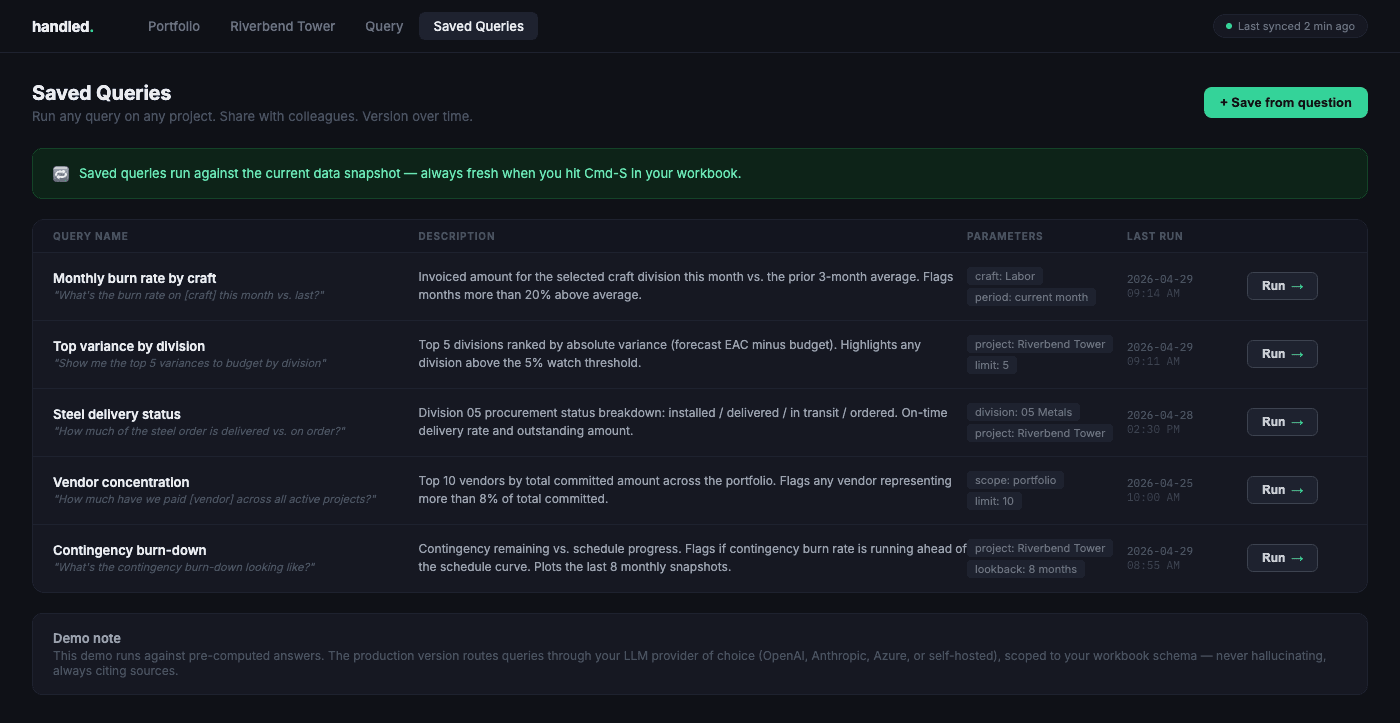
The eight to twelve questions that drive 80% of her daily inquiries became named queries — codified once, available everywhere. Every KPI has a written definition, a calculation, and a list of source rows it depends on.
Cockpit and query interface built
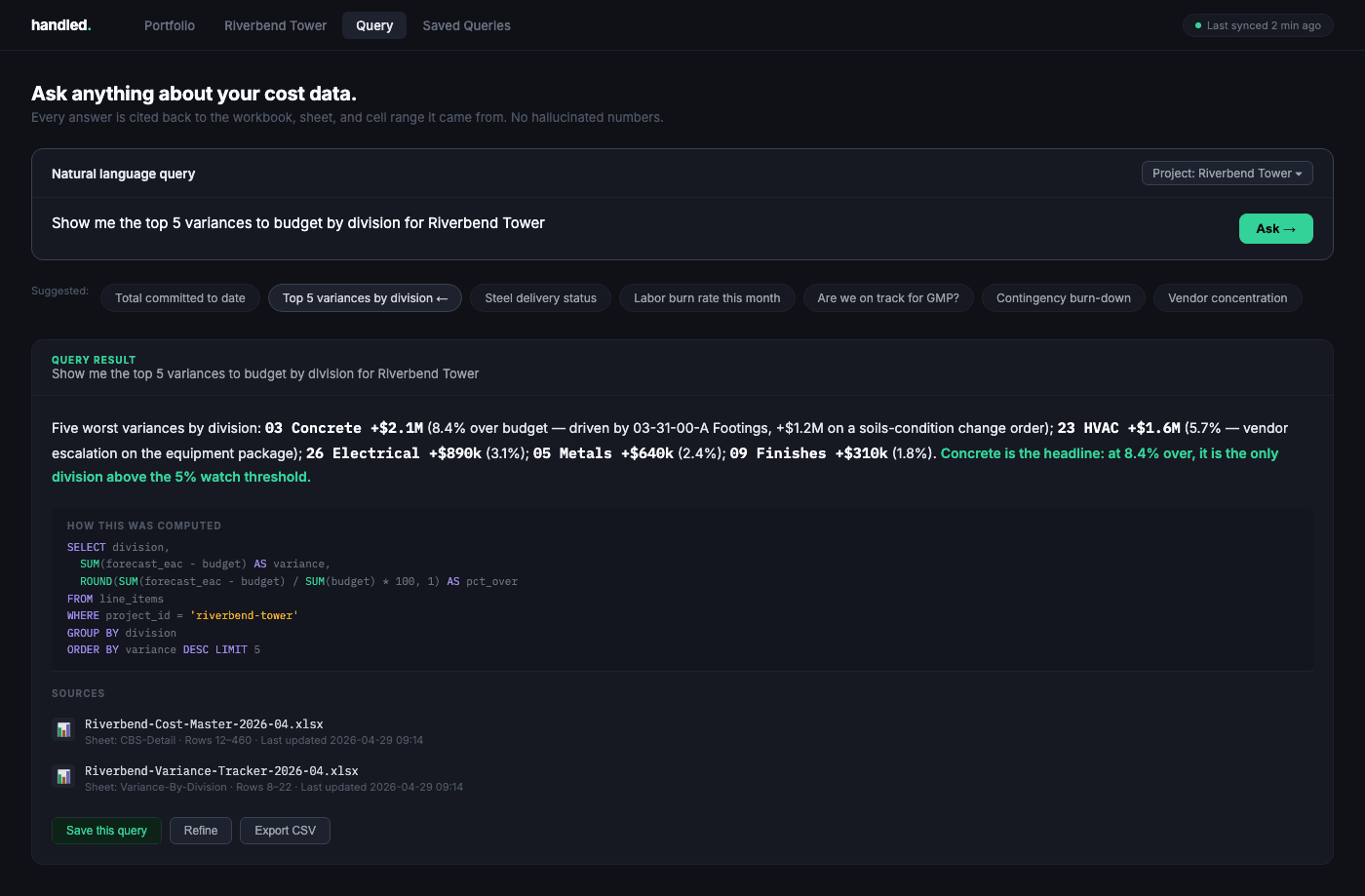
Static Next.js frontend, fast and offline-capable. Above the fold: the questions she gets asked. Below: the questions she asks herself, as a saved-query library. The natural-language input converts plain English to a structured query against the known schema — restricted, never hallucinating, always citing sources.
Refresh on save, no data team
No nightly batch. No pipeline ops role. The workbooks remain her source of truth; the cockpit updates the moment she hits Cmd-S. We handed her the source code, the schema doc, and a one-page operating manual.
Maybe you’ve got this problem too
The same pipeline works whenever you have hours of recorded knowledge that nobody can find later.
FP&A analysts and finance teams
Same pattern, financial workbooks instead of construction cost workbooks. The twelve monthly questions from the CFO become a live cockpit; the ad-hoc questions become saved queries; the close cycle stops depending on one person's availability.
Procurement and supply-chain managers
POs across multiple workbooks, vendor scorecards in spreadsheets, inventory tracked manually. Same pipeline, same cockpit shape — surface the answers, keep the source-of-truth where the team already maintains it.
Operations leaders at any data-rich business
Healthcare administrators tracking utilization, legal teams managing matter-level budgets, manufacturing managers tracking throughput. The bottleneck is universal: one person is the human cache for the team's spreadsheet questions. We replace the bottleneck without replacing the spreadsheets.
How the subscription works.
Throw up to three problems at us at once — we work on all of them. Pay $1,500/month while we’re building or refining. When everything’s signed off, billing pauses automatically. A lifetime guarantee covers anything we built that stops doing what we said it would.
- An ETL pipeline that watches her eight Excel workbooks and extracts each save into a clean analytical database — every row keeping its source file, sheet, and cell coordinates.
- A live portfolio cockpit with the four KPIs everyone pings her about above the fold, one tile per project, drillable to line-item variance.
- A natural-language query interface — ask in plain English, get an answer cited back to the workbook rows, with the SQL always visible and "not answerable from current data" when a question is out of scope.
- A saved-query library of the twelve questions that drive 80% of her daily inquiries — named, runnable on any project, shareable with colleagues.
- Source code + a one-page manual handed over, refreshing on every save with no data team — schema drift flagged when a workbook changes and fixed in the next free iteration.
Questions people ask.
Written by Gabriel Rymberg, Co-Founder, Handled. Last updated .MBA · Decades across enterprise and defense
Got eight spreadsheets and fifteen daily pings?
Describe the problem. Get The Plan in 5 business days. Decide whether to subscribe from there.